Đề kiểm tra 15 phút Chương 5 Vectơ sách CTST

Mô tả thêm: Đề kiểm tra 15 phút Toán 10 Vectơ gồm 20 câu hỏi trắc nghiệm giúp bạn học ôn tập, củng cố lại kiến thức sách Chân trời sáng tạo.
  • Thời gian làm: 15 phút
  • Số câu hỏi: 20 câu
  • Số điểm tối đa: 20 điểm
Trước khi làm bài bạn hãy
  • 1 Ôn tập kiến thức đã nêu trong phần Mô tả thêm
  • 2 Tìm không gian và thiết bị phù hợp để tập trung làm bài
  • 3 Chuẩn bị sẵn dụng cụ cần dùng khi làm bài như bút, nháp, máy tính
  • 4 Căn chỉnh thời gian làm từng câu một cách hợp lý
Mua gói để Làm bài
  • Câu 1: Nhận biết

    Điều kiện nào là điều kiện cần và đủ để I là trung điểm của đoạn thẳng AB?

    Điều kiện cần và đủ để I là trung điểm của đoạn thẳng AB\overrightarrow{IA} = - \overrightarrow{IB}
\Leftrightarrow \overrightarrow{IA} + \overrightarrow{IB} =
\overrightarrow{0}.

  • Câu 2: Nhận biết

    Trong mặt phẳng tọa độ Oxy cho \overrightarrow{a} = ( - 1;1),\overrightarrow{b} =
(4; - 2). Xác định tọa độ vecto \overrightarrow{v} = \overrightarrow{a} +
2\overrightarrow{b}?

    Ta có: \left\{ \begin{matrix}
\overrightarrow{a} = ( - 1;1) \Rightarrow 2\overrightarrow{a} = ( - 2;2)
\\
\overrightarrow{b} = (4; - 2) \\
\end{matrix} ight.

    \Rightarrow \overrightarrow{v} =
\overrightarrow{a} + 2\overrightarrow{b} = \left( - 2 + 4;2 + ( - 2)
ight) = (2;0)

  • Câu 3: Nhận biết

    Cho hình bình hành ABCD. Đẳng thức nào sau đây đúng?

    Ta có:

    \overrightarrow{AC} - \overrightarrow{AD}
= \overrightarrow{CD} sai do \overrightarrow{AC} - \overrightarrow{AD} =
\overrightarrow{DC}.

    \overrightarrow{AC} - \overrightarrow{BD}
= 2\overrightarrow{CD} sai do \overrightarrow{AC} - \overrightarrow{BD} =2\overrightarrow{CD}\Leftrightarrow \left( \overrightarrow{AB} +\overrightarrow{AD} ight) - \left( \overrightarrow{AD} -\overrightarrow{AB} ight)\mathbf{=}2\overrightarrow{CD}\Leftrightarrow 2\overrightarrow{AB} =2\overrightarrow{CD}.

    \overrightarrow{AC} + \overrightarrow{BC}
= \overrightarrow{AB} sai do \overrightarrow{AC} + \overrightarrow{BC} =\overrightarrow{AB} \Leftrightarrow \overrightarrow{AC} -\overrightarrow{AB} = - \overrightarrow{BC}\Leftrightarrow\overrightarrow{BC} = \overrightarrow{CB}.

    \overrightarrow{AC} + \overrightarrow{BD}
= 2\overrightarrow{BC} đúng do \overrightarrow{AC} + \overrightarrow{BD} =\overrightarrow{AB} + \overrightarrow{BC} + \overrightarrow{BC} +\overrightarrow{CD}\mathbf{=}2\overrightarrow{BC} + \left(\overrightarrow{AB} + \overrightarrow{CD} ight) = 2\overrightarrow{BC}+ \overrightarrow{0} = 2\overrightarrow{BC}.

  • Câu 4: Thông hiểu

    Trong hệ tọa độ Oxy, cho ba điểm A(1;1),\ B(3;2),\ C(6;5). Tìm tọa độ điểm D để tứ giác ABCD là hình bình hành.

    Gọi D(x;y). Ta có \left\{ \begin{matrix}
\overrightarrow{AB} = (2;1) \\
\overrightarrow{DC} = (6 - x;5 - y) \\
\end{matrix} ight.\ .

    Tứ giác ABCD là hình bình hành \Leftrightarrow \overrightarrow{AB} =
\overrightarrow{DC}

    \overset{}{ightarrow}\left\{\begin{matrix}2 = 6 - x \\1 = 5 - y \\\end{matrix} ight.\  \Leftrightarrow \left\{ \begin{matrix}x = 4 \\y = 4 \\\end{matrix} ight.\ \overset{}{ightarrow}D(4;4).

  • Câu 5: Nhận biết

    Khẳng định nào sau đây là đúng?

    Ta có \overrightarrow{a} =
\frac{5}{4}\overrightarrow{b}\overset{}{ightarrow}\overrightarrow{a},\
\overrightarrow{b} cùng hướng.

  • Câu 6: Vận dụng

    Cho hình thang ABCD có đáy là ABCD. Gọi MN lần lượt là trung điểm của ADBC. Khẳng định nào sau đây sai?

    M,\ \ N lần lượt là trung điểm của AD,\ \ BC \Rightarrow \left\{
\begin{matrix}
\overrightarrow{MA} + \overrightarrow{MD} = \overrightarrow{0} \\
\overrightarrow{BN} + \overrightarrow{CN} = \overrightarrow{0} \\
\end{matrix} ight.\ . Dựa vào đáp án, ta có nhận xét sau:

    \bullet \overrightarrow{MN} = \overrightarrow{MD} +
\overrightarrow{CN} + \overrightarrow{DC} đúng, vì \overrightarrow{MD} + \overrightarrow{CN} +
\overrightarrow{DC} = \overrightarrow{MN} = \left( \overrightarrow{MD} +
\overrightarrow{DC} ight) + \overrightarrow{CN} = \overrightarrow{MC}
+ \overrightarrow{CN} = \overrightarrow{MN}

    \bullet \overrightarrow{MN} = \overrightarrow{AB} -
\overrightarrow{MD} + \overrightarrow{BN} đúng, vì \overrightarrow{AB} - \overrightarrow{MD} +
\overrightarrow{BN} = \left( \overrightarrow{AB} + \overrightarrow{BN}
ight) - \overrightarrow{MD} = \overrightarrow{AN} -
\overrightarrow{AM} = \overrightarrow{MN}

    \bullet \overrightarrow{MN} =
\frac{1}{2}\left( \overrightarrow{AB} + \overrightarrow{DC}
ight) đúng, vì \overrightarrow{MN} = \overrightarrow{MA} +
\overrightarrow{AB} + \overrightarrow{BN}\overrightarrow{MN} = \overrightarrow{MD} +
\overrightarrow{DC} + \overrightarrow{CN}.

    Suy ra 2\overrightarrow{MN} = \left(
\overrightarrow{MA} + \overrightarrow{MD} ight) + \overrightarrow{AB}
+ \overrightarrow{DC} + \left( \overrightarrow{BN} + \overrightarrow{CN}
ight) = \overrightarrow{0} + \overrightarrow{AB} + \overrightarrow{DC}
+ \overrightarrow{0} = \overrightarrow{AB} +
\overrightarrow{DC}\overset{}{ightarrow}\overrightarrow{MN} =
\frac{1}{2}\left( \overrightarrow{AD} + \overrightarrow{BC}
ight).

    \bullet \overrightarrow{MN} =
\frac{1}{2}\left( \overrightarrow{AD} + \overrightarrow{BC}
ight) sai, vì theo phân tích ở đáp án trên. Chọn đáp án này.

  • Câu 7: Vận dụng cao

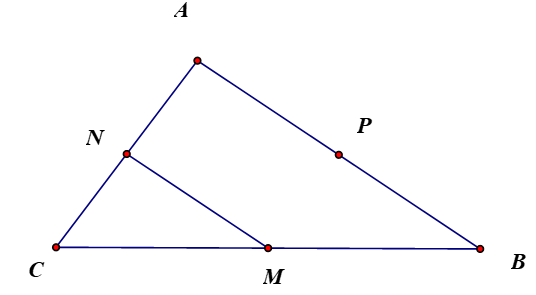
    Cho tam giác ABC đều cạnh a. Đường thẳng \Delta qua A và song song với BC, lấy điểm M \in \Delta. Tính giá trị nhỏ nhất của \left| \overrightarrow{CA} +
2\overrightarrow{MB} ight| khi M di động trên \Delta.

    Hình vẽ minh họa

    Kẻ hình bình hành ACBD. Gọi I là trung điểm BD, khi đó, ta có

    Ta có:

    \left| \overrightarrow{CA} +
2\overrightarrow{MB} ight| = \left| \overrightarrow{CA} + 2\left(
\overrightarrow{IB} - \overrightarrow{IM} ight) ight|

    = \left| \overrightarrow{CA} +
2\overrightarrow{IB} - 2\overrightarrow{IM} ight| = \left|
\overrightarrow{CA} + \overrightarrow{DB} - 2\overrightarrow{IM}
ight|

    = \left| \overrightarrow{CA} -
\overrightarrow{CA} - 2\overrightarrow{IM} ight|

    = 2\left| \overrightarrow{IM} ight|
\geq 2IH = 2.\frac{1}{2}.\frac{a\sqrt{3}}{2} =
\frac{a\sqrt{3}}{2}

    Dấu “=” xảy ra khi và chỉ khi M trùng với điểm H là hình chiếu vuông góc của điểm I trên đường thẳng \Delta.

  • Câu 8: Vận dụng

    Cho A(1;2),\ B( -
2;6). Điểm M trên trục Oy sao cho ba điểm A,B,M thẳng hàng thì tọa độ điểm M là:

    Ta có: M trên trục Oy \Rightarrow M(0;y).

    Ba điểm A,B,M thẳng hàng khi \overrightarrow{AB} cùng phương với \overrightarrow{AM}.

    Ta có \overrightarrow{AB} = ( - 3;4),\ \
\overrightarrow{AM} = ( - 1;y - 2). Do đó, \overrightarrow{AB} cùng phương với \overrightarrow{AM} \Leftrightarrow \frac{- 1}{-
3} = \frac{y - 2}{4} \Rightarrow y = \frac{10}{3}. Vậy M\left( 0;\frac{10}{3} ight).Đáp án là M\left( 0;\frac{10}{3} ight)

  • Câu 9: Thông hiểu

    Cho tam giác ABC vuông tại AAB = 3, AC = 4. Tính độ dài \overrightarrow{CB}+\overrightarrow{AB}.


    Đặt \overrightarrow {AB}=\overrightarrow {BD}.

    Ta có: \left| {\overrightarrow {CB}  + \overrightarrow {AB} } ight| = \left| {\overrightarrow {CB}  + \overrightarrow {BD} } ight| = \left| {\overrightarrow {CD} } ight| = CD.

    Áp dụng định lý Pytago trong tam giác ACD: CD = \sqrt {{6^2} + {4^2}}  = 2\sqrt {13}.

  • Câu 10: Thông hiểu

    Cho tam giác ABC. Gọi M, N, P lần lượt là trung điểm BC, AC, AB. Xác định các vectơ 

     \overrightarrow {PB}  + \overrightarrow {MC}  + \overrightarrow {NA}

    Ta có:

    \begin{matrix}  \overrightarrow {PB}  + \overrightarrow {MC}  + \overrightarrow {NA}  \hfill \\   = \overrightarrow {AP}  + \overrightarrow {PN}  + \overrightarrow {NA}  \hfill \\   = \overrightarrow {AP}  + \overrightarrow {PA}  = \overrightarrow 0  \hfill \\ \end{matrix}

  • Câu 11: Thông hiểu

    Cho ngũ giác ABCDE. Có bao nhiêu vectơ khác vectơ – không có điểm đầu và điểm cuối là đỉnh của ngũ giác đó?

    \overrightarrow{AB},\overrightarrow{AC},\overrightarrow{AD},\overrightarrow{AE}, \overrightarrow{BA},\overrightarrow{BC},\overrightarrow{BD},\overrightarrow{BE}, \overrightarrow{CA},\overrightarrow{CB},\overrightarrow{CD},\overrightarrow{CE}, \overrightarrow{DA},\overrightarrow{DC},\overrightarrow{DB},\overrightarrow{DE}, \overrightarrow{EA},\overrightarrow{EC},\overrightarrow{EB},\overrightarrow{ED}.

  • Câu 12: Nhận biết

    Cho tam giác ABCcân tại A, \widehat{A} = 120^{o} AB = a. Tính \overrightarrow{BA}.\overrightarrow{CA}.

    Ta có \overrightarrow{BA}.\overrightarrow{CA} =
BA.CA.cos120^{o} = - \frac{1}{2}a^{2}.

  • Câu 13: Thông hiểu

    Cho tam giác ABCM thỏa mãn điều kiện \overrightarrow{MA} + \overrightarrow{MB} +
\overrightarrow{MC} = \overrightarrow{0}. Xác định vị trí điểm M.

    Gọi G là trọng tâm tam giác ABC.

    Ta có \overrightarrow{GA} +
\overrightarrow{GB} + \overrightarrow{GC} = \overrightarrow{0}
\Rightarrow M \equiv G.

  • Câu 14: Nhận biết

    Cho ba điểm phân biệt M,N,P. Có bao nhiêu vectơ khác vectơ không có điểm đầu và điểm cuối là các điểm M,N,P đã cho?

    Các vectơ khác vectơ không có điểm đầu và điểm cuối là các điểm M,N,P đã cho là

    \overrightarrow{MN},\overrightarrow{NM},\overrightarrow{MP},\overrightarrow{PM},\overrightarrow{NP},\overrightarrow{PN}.

  • Câu 15: Nhận biết

    Gọi O là tâm hình vuông ABCD. Tính \overrightarrow{OB} -
\overrightarrow{OC}.

    Ta có \overrightarrow{OB} -
\overrightarrow{OC} = \overrightarrow{CB} =
\overrightarrow{DA}.

  • Câu 16: Vận dụng

    Cho tam giác ABC đều cạnh a, H là trung điểm của BC. Tính \left| \overrightarrow{CA} - \overrightarrow{HC}
ight|.

    Gọi D là điểm thỏa mãn tứ giác ACHD là hình bình hành

    \Rightarrow AHBD là hình chữ nhật.

    \left| \overrightarrow{CA} -
\overrightarrow{HC} ight| = \left| \overrightarrow{CA} +
\overrightarrow{CH} ight| = \left| \overrightarrow{CD} ight| =
CD.

    Ta có CD = \sqrt{BD^{2} + BC^{2}} =
\sqrt{AH^{2} + BC^{2}} = \sqrt{\frac{3a^{2}}{4} + a^{2}} =
\frac{a\sqrt{7}}{2}.

  • Câu 17: Thông hiểu

    Tam giác ABC vuông ở A và có góc \widehat{B} = 50^{o}. Hệ thức nào sau đây là sai?

    \left( \overrightarrow{AB},\
\overrightarrow{BC} ight) = 180^{0} - \left( \overrightarrow{AB},\
\overrightarrow{CB} ight) = 130^{o} nên loại \left( \overrightarrow{AB},\ \overrightarrow{BC}
ight) = 130^{o}.

    \left( \overrightarrow{BC},\
\overrightarrow{AC} ight) = \left( \overrightarrow{CB},\
\overrightarrow{CA} ight) = 40^{o} nên loại \left( \overrightarrow{BC},\ \overrightarrow{AC}
ight) = 40^{o}.

    \left( \overrightarrow{AB},\
\overrightarrow{CB} ight) = \left( \overrightarrow{BA},\
\overrightarrow{BC} ight) = 50^{o} nên loại \left( \overrightarrow{AB},\ \overrightarrow{CB}
ight) = 50^{o}.

    \left( \overrightarrow{AC},\
\overrightarrow{CB} ight) = 180^{0} - \left( \overrightarrow{CA},\
\overrightarrow{CB} ight) = 140^{o}nên chọn \left( \overrightarrow{AC},\ \overrightarrow{CB}
ight) = 120^{o}.

  • Câu 18: Nhận biết

    Cho tam giác đều ABC có cạnh bằng a. Tính tích vô hướng \overrightarrow{AB}.\overrightarrow{AC}.

    \overrightarrow{AB}.\overrightarrow{AC}.
= \left| \overrightarrow{AB} ight|.\left| \overrightarrow{AC}
ight|.cos\left( \overrightarrow{AB},\overrightarrow{AC} ight) =
a.a.cos60^{{^\circ}} = \frac{a^{2}}{2}.

  • Câu 19: Thông hiểu

    Trong mặt phẳng tọa độ Oxy, cho tọa độ các điểm M( - 3;1),N(1;4),P(5;3). Xác định tọa độ điểm Q sao cho tứ giác MNPQ là hình bình hành?

    Gọi tọa độ điểm Q(x;y)

    Ta có: \left\{ \begin{matrix}
\overrightarrow{MQ} = (x + 3;y - 1) \\
\overrightarrow{NP} = (4; - 1) \\
\end{matrix} ight.

    Vì MNPQ là hình bình hành nên

    \overrightarrow{MQ} =
\overrightarrow{NP} \Leftrightarrow \left\{ \begin{matrix}
x + 3 = 4 \\
y - 1 = - 1 \\
\end{matrix} ight.\  \Leftrightarrow \left\{ \begin{matrix}
x = 1 \\
y = 0 \\
\end{matrix} ight.

    Vậy tọa độ điểm Q cần tìm là Q(1;0).

  • Câu 20: Nhận biết

    Cho ba điểm A,\
B,\ C phân biệt. Điều kiện cần và đủ để ba điểm đó thẳng hàng là

    Ta có tính chất: Điều kiện cần và đủ để ba điểm A,\ B,\ C phân biệt thẳng hàng là \exists k \in R:\overrightarrow{AB} =
k\overrightarrow{AC}.

Chúc mừng Bạn đã hoàn thành bài!

Đề kiểm tra 15 phút Chương 5 Vectơ sách CTST Kết quả
  • Thời gian làm bài: 00:00:00
  • Số câu đã làm: 0
  • Điểm tạm tính: 0
  • 42 lượt xem
Sắp xếp theo